AI Governance
Innovation LUX CEO Christiane Lesch Contributes Expert Note to
Patric Weiler’s New Book “AI Leadership Code”
Why building a governance culture before scaling AI is essential for responsible transformation, organisational resilience and sustainable business value.
Artificial intelligence is rapidly becoming part of everyday business operations.
Yet as companies accelerate AI adoption, a fundamental leadership question is becoming increasingly urgent: Who is accountable for ensuring that AI is deployed responsibly, securely and in ways that create lasting business value?
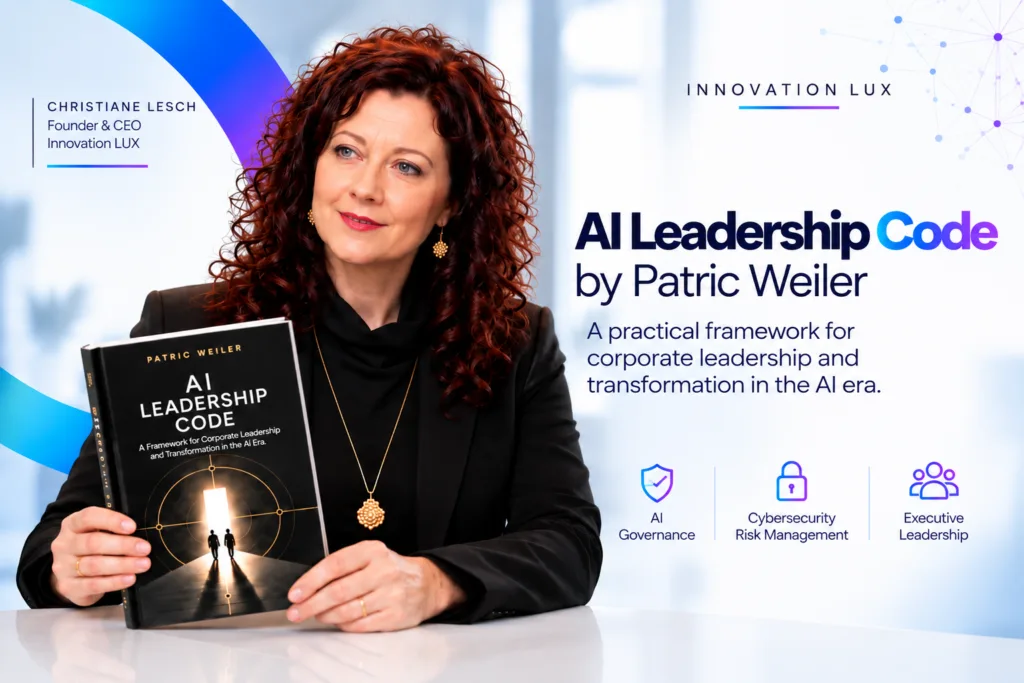
This question lies at the heart of “AI Leadership Code: A Framework for Corporate Leadership and Transformation in the AI Era,” the new management book by international executive advisor and AI leadership expert Patric Weiler.
Christiane Lesch, Founder and CEO of Innovation LUX S.à r.l., has contributed an exclusive Expert Note on AI Governance to the book, bringing her perspective on executive accountability, governance culture, cybersecurity risk management and sustainable organisational transformation.
Her central message is clear:
“Build a governance culture before scaling AI.”
From AI Adoption to Responsible AI Leadership
For many companies, the challenge is no longer simply gaining access to AI technologies. It is establishing the leadership structures, decision-making processes and organisational capabilities needed to turn AI investments into measurable results.
AI initiatives frequently span multiple departments, including IT, legal, information security, compliance and business operations. While each function may fulfill its individual responsibilities, end-to-end accountability can remain fragmented.
Without clearly defined ownership, governance mechanisms and escalation processes, companies risk scaling AI faster than their ability to oversee it.
In her Expert Note, Christiane Lesch argues that AI Governance must be embedded in corporate leadership from the outset, rather than introduced as an afterthought once technologies have already been deployed.
“AI Governance is not simply a technical, legal or compliance matter. It is a strategic leadership responsibility that belongs on the agenda of CEOs, executive boards and supervisory boards,” says Lesch.
For Innovation LUX, effective governance is not about slowing down innovation. It is about creating the conditions under which innovation can scale with confidence.
Why AI Governance and Cybersecurity Risk Management
Belong Together
A key focus of Christiane Lesch’s contribution is the strategic connection between AI Governance and cybersecurity governance.
As many companies integrate AI into business-critical processes, questions of data access, model usage, information security, third-party dependencies and incident response become increasingly important.
AI Governance establishes the strategic guardrails for responsible deployment. Cybersecurity governance translates these principles into operational responsibilities, security controls, escalation procedures and reporting structures.
Together, they provide the foundation for organisational resilience.
From an executive perspective, four questions are particularly important:
- Who makes the decisions? Clear ownership and accountability must be established across the organisation.
- On what basis are decisions made? AI-related decisions require transparent criteria, appropriate oversight and a defined risk appetite.
- How are risks monitored? Organisations need mechanisms to identify, assess and continuously review emerging AI and cybersecurity risks.
- How are issues escalated? Effective governance depends on clear reporting lines, incident-response responsibilities and timely executive involvement.
These questions are especially relevant as many companies navigate evolving regulatory expectations, including the EU AI Act and the NIS2 cybersecurity framework, where applicable.
Governance should enable responsible innovation, not become a bureaucratic obstacle to it.
As Christiane Lesch emphasises:
“AI creates opportunities. Leadership transforms them into business value. Governance safeguards their sustainability. Before companies scale AI, they must establish a living governance culture in which responsibilities, decision-making processes and risk management are clearly embedded. Governance is not a bureaucratic brake; it is a prerequisite for secure, resilient and economically successful AI transformation.”
“AI Leadership Code”: A Practical Framework for
Executive Decision-Making
In his new book, Patric Weiler draws on approximately 30 years of international leadership and entrepreneurial experience, including senior management and board-level responsibilities, as well as extensive experience in applied AI.
Rather than approaching artificial intelligence as an isolated technology initiative, Weiler presents AI transformation as a comprehensive management and leadership challenge.
Across more than 400 pages and ten chapters, the AI Leadership Code provides a structured framework designed to help executives address the strategic, economic, organisational and governance dimensions of AI adoption.
The book combines six central leadership dimensions with practical frameworks, decision-making tools and implementation guidance.
Its objective is to help companies move beyond fragmented AI experiments towards strategically aligned initiatives that deliver measurable enterprise value.
For CEOs, board members and senior executives, the book offers a practical perspective on what it takes to lead companies and teams successfully through the AI era.
Expert Perspectives on Leadership,
Transformation and Governance
Alongside Christiane Lesch’s Expert Note on Governance, the book features contributions from two other recognised experts:
Norman Müller, Chairman of the German Federal Association for AI Transformation (Bundesverband für KI-Transformation e.V.), provides the foreword, examining why artificial intelligence has become a defining leadership challenge.
Katrin J. Yuan, CEO of Swiss Future Institute AG, contributes an Executive Perspective on the new mindsets and capabilities required for leadership in the AI era.
Together, these perspectives complement Patric Weiler’s leadership framework and reinforce a central principle: successful AI transformation requires more than technological expertise. It requires strategic direction, organisational readiness, responsible decision-making and effective governance.
A Long-Standing Professional Collaboration
Christiane Lesch’s contribution to AI Leadership Code also reflects a long-standing professional collaboration with Patric Weiler.
The two first met as lecturers at the Münchner Marketing Akademie during the early period of the generative AI boom. Since then, they have designed and delivered a range of executive workshops for international companies across different industries.
Their joint work has included crisis communication workshops for international managers at a financial services company, strategic foresight and future-oriented leadership workshops, and cybersecurity risk management training for executives in the mechanical engineering sector.
Today, their collaboration continues to focus on helping leaders understand the strategic opportunities, governance requirements and risk implications of digital and AI-driven transformation.
This practical experience informs their shared conviction that AI transformation succeeds when leadership, strategy, people and governance are addressed together.
Innovation LUX: Supporting Responsible
and Sustainable AI Transformation
At Innovation LUX, we work at the intersection of international strategy, executive leadership, AI transformation, governance and risk management.
Our approach is grounded in the belief that technological progress must be accompanied by clear strategic priorities, accountable leadership and resilient organisational structures.
For companies seeking to scale AI responsibly, this means moving beyond individual tools and pilot projects towards an integrated management approach that connects innovation with governance, cybersecurity and measurable business outcomes.
Christiane Lesch’s Expert Note in the book the AI Leadership Code reflects this philosophy and contributes an executive-level perspective to the wider discussion about responsible AI leadership.
The message for business leaders is straightforward: AI adoption alone does not create sustainable competitive advantage. The ability to lead, govern and scale AI responsibly does.
Discover “AI Leadership Code” by Patric Weiler
AI Leadership Code – A Framework for Corporate Leadership and Transformation in the AI Era is designed for CEOs, board members, senior executives and transformation leaders who want to move from AI experimentation to structured, value-driven implementation.
The book is available for pre-order.
Learn more and pre-order the book:
https://www.pwbc.de/buch
About Christiane Lesch and Innovation LUX
Christiane Lesch is the Founder and CEO of Innovation LUX S.à r.l., an international strategy and executive advisory consultancy based in Luxembourg. With more than 25 years of international business and leadership experience, she advises companies and leaders on strategic transformation, AI leadership, governance, cybersecurity risk management and sustainable innovation.
Through Innovation LUX, she supports executives and their teams in aligning technological innovation with leadership accountability, organisational resilience and long-term value creation.
Website: https://innovation-lux.com
Comments are closed