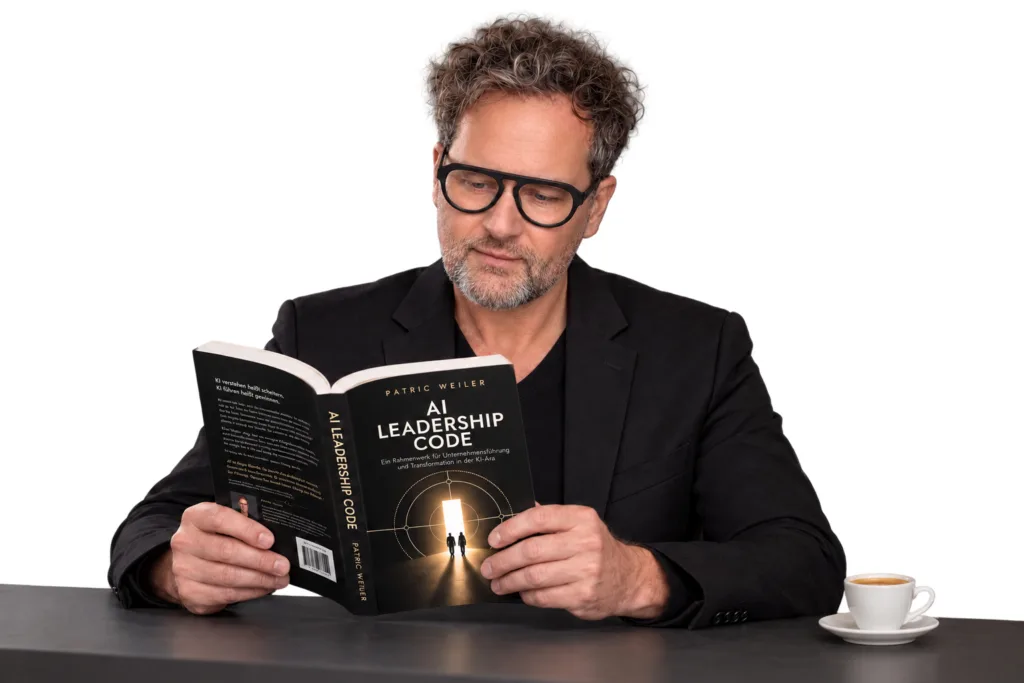
Only six out of one hundred companies achieve a noticeable impact on earnings with AI.
In the new management book “AI Leadership Code,” Patric Weiler shows what the few do differently.
Luxembourg, 16 November 2026. Artificial intelligence has arrived in business, yet its economic returns fail to materialize in most companies. According to the McKinsey’s report “The State of AI” (August 2026), 88 percent of the companies surveyed use AI regularly. Only six percent attribute more than five percent of their operating earnings (EBIT) to AI, a proportion that has not changed compared with the previous year. At the same time, the governance gap is growing: In an IBM study of 2,000 chief technology officers published in June 2026, 77 percent report that AI adoption in their company is progressing faster than their governance capabilities. Both findings point to a common management task: Alongside the use of technology, strategy, decision-making structures and structures of responsibility must also be developed further. (Sources: McKinsey, The State of AI 2026; IBM Institute for Business Value, June 2026)
Which AI initiatives deserve priority, and how can their economic benefit be recognized?
Is the company ready for this, from skills and data to technical infrastructure?
How does leadership win over the workforce to change, and who bears responsibility for implementation and risks?
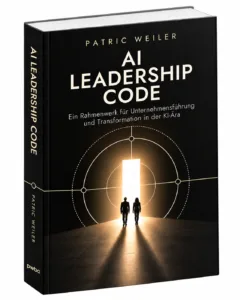
These are the questions addressed by Patric Weiler’s new management book “AI Leadership Code: A Framework for Corporate Leadership and Transformation in the AI Era.” It is published on 16 November 2026 by pwbc, is available on Amazon as a hardcover, paperback and e-book, and is aimed at board members, executive management, supervisory boards, entrepreneurs and leadership teams.
Patric Weiler, a management consultant for AI strategy and transformation and a multiple award recipient in 2026 (including Bundesverband KI Expert Excellence Award 2026, Top 100 AI Future Council Member, AI Consultancy Company of the Year Germany 2026), attributes this difference not to technology but to leadership.
His thesis: AI changes not only how a company works. It changes who it is. His book combines strategy, value creation, corporate identity, organization, AI readiness, governance and the human dimension into a leadership system for the AI era. People are not on the sidelines: The psychological dimension is the overarching link that determines the success of all other steps. The book shows leaders how they can turn technological ambitions into measurable economic results, greater investment certainty and sustainable competitive advantages.
“What matters is not how many AI tools are used or pilot projects launched, but what measurable economic contribution they make to the company. Most companies fail not because of the technology but because of leadership: They start with the tool instead of their strategic goals. Successful leadership teams need a clear strategic framework, binding responsibilities and the ability to lead people and structures through the transformation. Because artificial intelligence begins with human intelligence,” emphasizes Patric Weiler.
“Anyone who uses AI exclusively to make existing processes faster and cheaper is optimizing the caterpillar. They make it more capable, leaner and perhaps more profitable. But they leave it a caterpillar,” writes Norman Müller, Chairman of the Board of Bundesverband für KI-Transformation e.V., in his foreword. His assessment of the book: “The book does not provide yet another catalogue of supposedly indispensable tools. It organizes the leadership questions that come before and after every serious AI transformation.”
The book describes the path from caterpillar to butterfly, from an optimized company to a reimagined company, as a leadership task.
Six leadership questions instead of isolated technology projects
The book structures AI transformation around six leadership questions that every company’s management must answer for its own organization:
1.Strategic direction: Which strategic goals does the company want to achieve in the next 24 to 36 months, and how can AI help?
2. Economic value: Where is the greatest economic leverage from AI, and where does the company focus its efforts first?
3. Identity: How does the company use AI in a way that sharpens its identity and particular strength instead of making it more interchangeable?
4. Capabilities: Does the company have the people, skills, data, processes and technologies to implement and scale its AI strategy?
5. Responsibility and governance: Who decides on the use of AI, and how are risks managed?
6. Embedding it among people: How is change led and communicated so that employees understand AI, help shape it and support it sustainably in everyday work?
Five of these questions form the methodological steps of the AI Leadership Code. The sixth, embedding it among people, is not another step but the link that encompasses all the others: It determines whether a good plan becomes lived practice. In this way, leadership teams assess AI initiatives not only by their technical feasibility but also by their contribution to corporate strategy, the prerequisites for their implementation and responsibility for their results.
To assess the current position, the book contains a self-test with 24 statements, four for each leadership question. In just a few minutes, it shows a leadership team where its strategy holds up and where it merely looks good.
Additional perspectives on leadership and responsibility
Three contributions expand on the author’s approach: Norman Müller, Chairman of the Board of Bundesverband für KI-Transformation e.V., explains in the foreword the importance of AI as a leadership task.
Katrin J. Yuan, CEO of Swiss Future Institute AG and a supervisory board member in Germany and Switzerland, brings the perspective of supervisory bodies to her “Executive Perspective”: “The question is no longer whether a company uses AI. It is whether its leadership can lead AI.” She writes about the author: “Patric is among the voices I greatly value in the AI Future Council Top 100 — because he asks the leadership question before talking about technology.”
Christiane Lesch, CEO of Innovation LUX, examines the role of governance, trust and responsibility in her “Expert Note Governance.” “Companies are investing massively in AI, but governance is not developing at the same pace. Silos and unclear responsibilities slow down implementation. Governance rarely fails because of a lack of good intentions, but because no one feels responsible. That is precisely where the actual business risk arises,” explains Christiane Lesch.
This also concerns the connection between the ability to innovate and risk management: Companies need not only ideas for new applications but also transparent decisions about who is responsible for their use, which risks are acceptable and how their impact is reviewed.
Topics for discussion
Patric Weiler is available for interviews, guest articles and background discussions, including on the following topics:
Why 94 out of 100 companies achieve no noticeable impact on earnings with AI
Why AI changes who a company is and where its value creation shifts
What executive management and supervisory boards must decide now, from strategy to governance
Augmented Intelligence: why the future of leadership lies not in automation but in the combination of human and machine intelligence
About the author
Patric Weiler is a management consultant for AI strategy and transformation and works with boards, executive management, supervisory boards and entrepreneurs, from DAX-listed corporations and internationally leading US corporations to medium-sized businesses. He has himself held leadership responsibility for around three decades, including as Head of Strategy and simultaneously Deputy Country Manager Germany at American Express Global Business Travel, as a member of the management team and Head of Sales and Marketing of the German subsidiary of the energy group PGNiG SA (now Orlen), and as co-founder and managing director of one of the first digital agencies in the German-speaking region. Since 2016, he has brought together artificial intelligence and corporate strategy. His view of AI transformation is business-oriented, technological and psychological: In addition to an international MBA, he holds a degree in social sciences with a focus on organizational psychology, the reason why technology, value creation and people are not treated separately in his book. As a university lecturer and management trainer, he has trained more than 1,000 specialists and executives. His consulting company pwbc was named AI Consultancy Firm of the Year Germany in 2026. In the same year, he received the Expert Excellence Award from Bundesverband für KI-Transformation and was appointed to the AI Future Council Top 100 of the Swiss Future Institute. https://www.pwbc.de/buchhttps://www.pwbc.de/buch
Book information
Title: AI Leadership Code
Subtitle: A Framework for Corporate Leadership and Transformation in the AI Era
Author: Patric Weiler
With a foreword by Norman Müller and contributions by Katrin J. Yuan and Christiane Lesch
Publisher: pwbc, Patric Weiler Business Consulting
Distribution: Amazon
Publication date: 16 November 2026
Length: 392 pages
Formats and prices:
Hardcover €38
Paperback €28,
Kindle €25.99
ISBN: 978-3-9829764-0-2 / 978-3-9829764-1-9
Further information and reading sample: https://www.pwbc.de/buch
Review copies and press materials available at: press@innovation-lux.com
Press contact
Innovation LUX S.à r.l.
13–15 Avenue de la Liberté
1931 Luxembourg
Telephone: +352 27866 929
Email: press@innovation-lux.com
Website: https://innovation-lux.com
Requests for interviews, guest articles and background discussions with Patric Weiler to press@innovation-lux.com
Image download

Patric Weiler Author AI Leadership Code

Patric_Weiler_white background_300dpi
04_AI_Leadership_Code_Book_300dpi

Patric_Weiler_ holding his book_300dpi

Patric_Weiler_White Background_300dpi
Comments are closed